
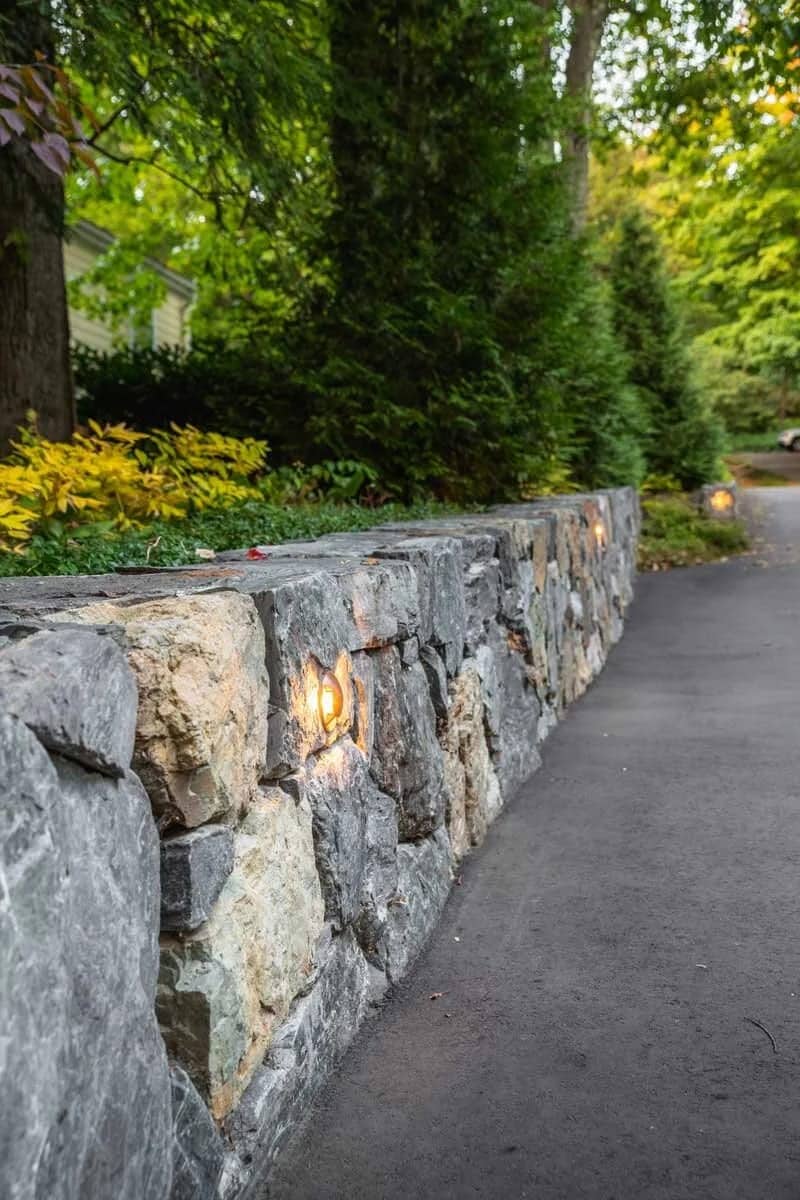
Stone Walls · Dunstable, MA
Stone Walls in Dunstable, Massachusetts.
Building stone walls in Dunstable starts underground, on stony glacial till over Merrimack-belt schist and ledge. A quiet farming town of large wooded lots and gentleman's farms where stonework reads as part of the working landscape. We hand-set every stone to suit the preserved Colonial-era farmhouses of nashoba Valley, and we build it to still be plumb in thirty years.
Problems We Solve
Common stone walls problems in Dunstable — solved.
A steep or eroding slope you can’t use.
An engineered retaining wall turns it into level, planted, usable ground that holds for generations.
An existing wall that’s bulging, leaning, or cracking.
That’s a drainage failure, not a stone one. We rebuild on a real footing with a weep system behind it so it never repeats.
You want privacy and a defined property line.
A hand-stacked fieldstone wall frames the land the way New England has for centuries — and looks original to it.
Planning stone walls in Dunstable? Call (508) 922-1836 or request your free quote — most consultations are booked within a business day.
Working from a plan in Dunstable
If you are coming to us with a plan already drawn, we build it as drawn. We read grading and layout sheets fluently, hold the detail, and keep the designer informed at each milestone — the way we work with Jonathan Keep Landscape Design across Massachusetts.
Walls that hold Dunstable’s ground
A wall in Dunstable is a drainage structure before it is a stone one. Rolling wooded uplands and old farm fields drained by Salmon Brook and the Massapoag ponds sit on stony glacial till over Merrimack-belt schist and ledge, studded with the fieldstone that built the town's old walls — and that is where a wall lives or dies. We excavate to a compacted base below frost depth and build a weep-and-drainage channel behind every retaining wall, so the hydrostatic pressure of a New England winter never gets the leverage to push it out of plumb.
Turn a sloped Dunstable lot into level, planted, usable ground and — built this way — it stays that way, quietly, for decades.
Fieldstone matched to Dunstable
Freestanding fieldstone is the older language of Nashoba Valley, and it is what makes new work read as though it belongs. We source local stone, sort it by hand on site, and dry-stack so each stone carries load to the ones below it — no mortar hiding a mistake. The result carries the settled, irregular character of the walls already standing around Dunstable Center, Massapoag Pond, and Blanchard Hill.
Where the preserved Colonial-era farmhouses, antique capes, and estate homes on multi-acre parcels call for a cleaner line — a granite-capped seat wall, a mortared wall against a foundation — we build that too, matched to the house and the planting plan.
Budgeting stone walls in Dunstable
We would rather explain the number than defend it. In Dunstable, the swing factors are access, excavation depth over stony glacial till over Merrimack-belt schist and ledge, drainage, and protection of what is already growing on the property — the stone itself is rarely the deciding line.
You get an itemized scope after we walk the property — what is included, what is not, and where the money actually goes. No allowances that quietly become change orders halfway through.
Beyond Dunstable
Dunstable sits in Middlesex County, and most weeks we are somewhere in this pocket of Nashoba Valley — which means shorter travel, faster site visits, and a crew that already knows how ground behaves around here.
Questions
Stone Walls in Dunstable, answered.
Rolling wooded uplands and old farm fields drained by Salmon Brook and the Massapoag ponds on stony glacial till over Merrimack-belt schist and ledge, studded with the fieldstone that built the town's old walls. That governs how we found and drain everything we build here — a proper base and drainage go in before a single stone is set, which is what keeps Dunstable stonework flat, plumb, and intact through freeze-thaw.
Usually, yes. We hand-select from regional yards to match color, cleft, and scale against what is already on the property — which matters in Dunstable, where the preserved Colonial-era farmhouses tend to be added to over time rather than replaced.
Both. Dry-stacked fieldstone for the classic New England look and freestanding walls; mortared and granite-capped construction where the design calls for a crisper line or structural tie-in. We recommend the right method for the wall’s job and your aesthetic.
Most residential work runs one to three weeks on site, depending on size, access, and how much excavation stony glacial till over Merrimack-belt schist and ledge demands. You get a real schedule before we start, and we hold it — including the clean-up at the end of each day.
Request a Consultation
Planning stone walls in Dunstable?
Tell us about your property. We’ll walk the site, talk materials, and give you a clear plan — most consultations are booked within a business day.
Response within one business day.