
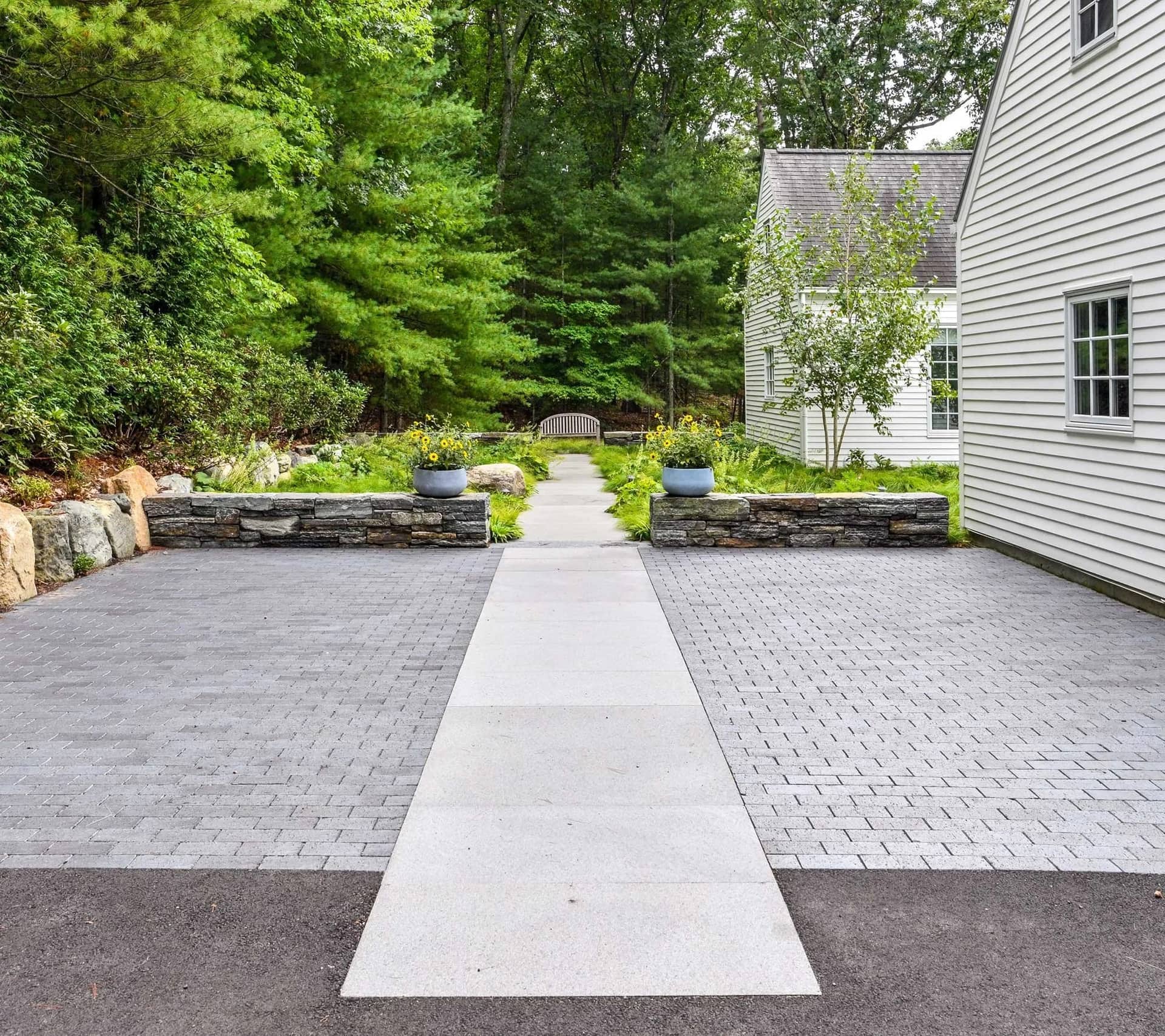
Walkways · Longmeadow, MA
Walkways in Longmeadow, Massachusetts.
The Green, Longmeadow Street, and western Massachusetts’ estate row. Across Hampden County we build walkways the slow way — excavated to depth over river-terrace sand and silt — easy to dig, drained properly, and hand-fitted to the colonial revival and Tudor estates lining Longmeadow Street that define Longmeadow.
Problems We Solve
Common walkways problems in Longmeadow — solved.
A cracked, uneven front walk that’s a trip hazard.
We reset it on a base below frost with consistent risers, so every step lands the same and stays safe.
An entrance that underwhelms for the house behind it.
A composed stone approach — curves, landings, lighting — makes the walk to the door match the home.
Steps or grade changes that wobble or look cheap.
Granite and bluestone treads on real foundations, set true — that’s where the craft shows.
Planning walkways in Longmeadow? Call (508) 922-1836 or request your free quote — most consultations are booked within a business day.
Stone that matches the front of the house
Thermal bluestone for a crisp, formal entrance; irregular fieldstone for something softer and more rooted; granite treads for steps that will see a century of footsteps. We match the stone to the colonial revival and Tudor estates lining Longmeadow Street so the walk looks original to the home — in Longmeadow Street, the Green, and Blueberry Hill and across Longmeadow.
Most front walks involve a grade change, and steps are where cheap work shows first. We set granite and bluestone treads on proper foundations with consistent risers, so every step lands the same.
Beyond Longmeadow
Longmeadow sits in Hampden County. We travel for estate work across Massachusetts, and when a project takes us to western MA we plan logistics and material delivery around the distance rather than pretending it does not exist.
The approach to a Longmeadow door
A walkway is the first handshake a house gives, and in Longmeadow it takes the hardest freeze-thaw punishment of anything we build. Set on river-terrace sand and silt — easy to dig, unforgiving without compaction, a front walk needs even more base and drainage discipline than a patio — which is exactly how we build it, to stay flat and trip-free for the long haul.
We lay out curves, landings, and step transitions so the approach across flat Connecticut River terraces under a canopy of old street trees feels composed: generous at the entry, comfortable underfoot, and lit for arriving after dark.
Choosing material that suits Longmeadow
Stone varies wildly pallet to pallet, so we select it ourselves. In Longmeadow, where the local character runs to colonial revival and Tudor estates lining Longmeadow Street, getting the color and cleft right matters more than the grade printed on the invoice.
How a Longmeadow project runs
A job in Longmeadow is a few weeks of trucks, machines, and people in your yard. We plan staging and protection before day one — drive plates, root-zone protection, a defined material area — and leave the site clean each evening rather than at the end.
Questions
Walkways in Longmeadow, answered.
Flat Connecticut River terraces under a canopy of old street trees on river-terrace sand and silt — easy to dig, unforgiving without compaction. That governs how we found and drain everything we build here — a proper base and drainage go in before a single stone is set, which is what keeps Longmeadow stonework flat, plumb, and intact through freeze-thaw.
Yes. We source stone to match existing bluestone or granite as closely as the material allows, and carry the joint and pattern language through so the new work reads as part of the original.
Longmeadow Street’s estate row and the historic Green set the town’s standard — mature grounds where new stone has to look like it was always part of the plan. We handle the local checks that go with that as part of the project rather than leaving them to you.
Most residential work runs one to three weeks on site, depending on size, access, and how much excavation river-terrace sand and silt — easy to dig demands. You get a real schedule before we start, and we hold it — including the clean-up at the end of each day.
Request a Consultation
Planning walkways in Longmeadow?
Tell us about your property. We’ll walk the site, talk materials, and give you a clear plan — most consultations are booked within a business day.
Response within one business day.